


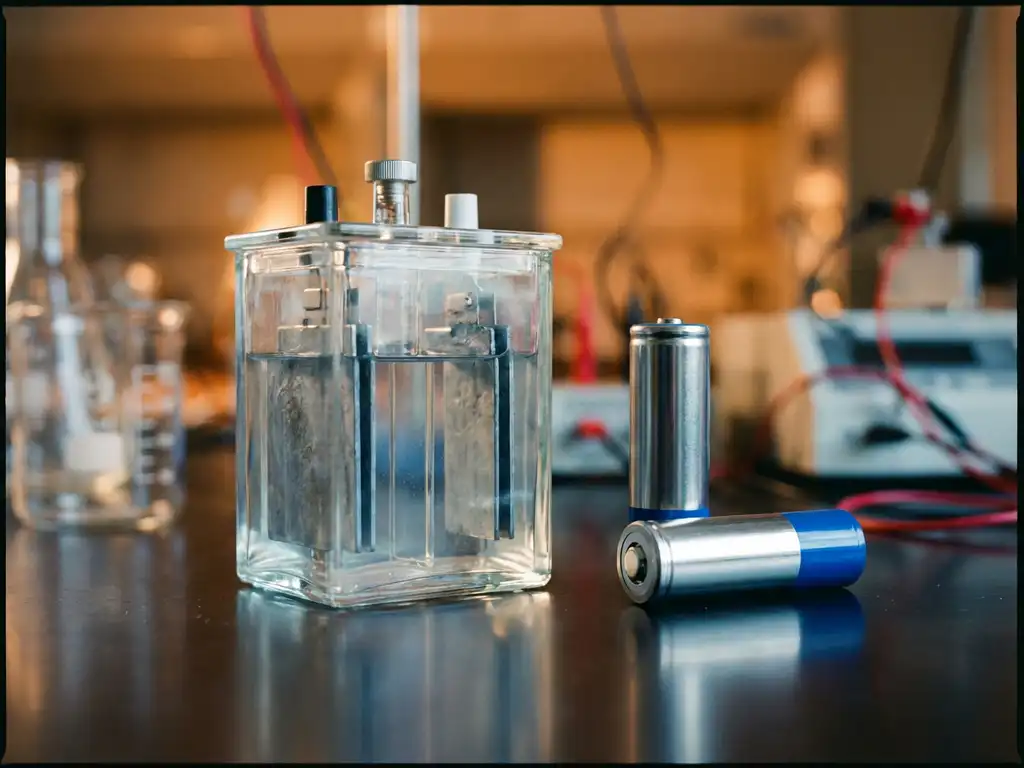
A wet cell battery and a lithium-ion battery are distinct electrochemical systems that differ in electrolyte composition, electrochemistry, and application. Understanding these differences is relevant for battery materials researchers who work across multiple cell chemistries and need to select appropriate test platforms for their experimental work.
This article addresses the key distinctions between wet cell and lithium-ion battery technologies, clarifies a common source of terminological confusion, and considers which system is more relevant in electrochemical research contexts.
What is a wet cell battery?
A wet cell battery is an electrochemical cell that uses a liquid electrolyte—typically an aqueous solution—in which the electrodes are fully immersed. The lead-acid battery is the most widely studied example, using sulfuric acid as the electrolyte alongside lead and lead dioxide electrodes. Wet cells are among the oldest battery technologies and remain in use in applications where cost and robustness are prioritised over energy density.
The term “wet cell” distinguishes these systems from dry cell batteries, where the electrolyte is immobilised in a paste or gel rather than existing as a free liquid. In a wet cell, ionic conductivity depends on the mobility of ions through the aqueous electrolyte, and the electrochemical reactions at each electrode are governed by the specific chemistry of the active materials and the electrolyte composition.
What are the main types of wet cell batteries?
The lead-acid battery is the canonical wet cell, but the category also includes flooded nickel-cadmium (Ni-Cd) and nickel-metal hydride (Ni-MH) cells in their vented configurations. Each system operates via different electrode reactions but shares the defining characteristic of a free liquid electrolyte. Researchers studying aqueous electrochemistry or legacy battery chemistries will encounter wet cell systems in both historical literature and active research programmes focused on low-cost grid storage.
What is a lithium-ion battery and how does it work?
A lithium-ion battery is a rechargeable electrochemical cell in which charge is stored and released through the reversible intercalation of lithium ions between a positive electrode (cathode) and a negative electrode (anode). During discharge, lithium ions move from the anode through a non-aqueous electrolyte to the cathode; during charge, this process reverses. The electrolyte is typically a lithium salt dissolved in an organic solvent, not water.
The electrochemical performance of a lithium-ion cell is characterised by parameters such as specific capacity (mAh/g), coulombic efficiency, and C-rate behaviour. On the first charge cycle, a passivation layer known as the solid electrolyte interphase (SEI) forms on the anode surface. The SEI layer consumes some lithium irreversibly, reducing coulombic efficiency in early cycles, but stabilises the electrode–electrolyte interface for subsequent cycling. Understanding and controlling SEI formation is a central topic in contemporary lithium-ion research.
What materials are used in lithium-ion electrodes?
Common anode materials include graphite, silicon, and lithium titanate (Li₄Ti₅O₁₂). Cathode materials include layered oxides such as lithium nickel manganese cobalt oxide (NMC), lithium iron phosphate (LFP), and lithium cobalt oxide (LCO). The choice of electrode materials directly determines the cell voltage, specific capacity, and cycle life, and is the primary variable in most academic battery research programmes.
What are the key differences between a wet cell and a lithium-ion battery?
The primary difference between a wet cell battery and a lithium-ion battery lies in the electrolyte: wet cells use an aqueous liquid electrolyte, whereas lithium-ion batteries use a non-aqueous organic electrolyte. This distinction drives differences in operating voltage, energy density, safety profile, and the underlying electrode chemistry.
- Electrolyte: Wet cells use aqueous solutions (e.g., sulfuric acid in lead-acid); lithium-ion cells use organic solvents with dissolved lithium salts (e.g., LiPF₆ in ethylene carbonate/dimethyl carbonate).
- Operating voltage: Aqueous electrolytes are limited to approximately 1.23 V before water electrolysis occurs. Lithium-ion cells typically operate between 2.5 V and 4.2 V per cell, enabling significantly higher energy density.
- Energy density: Lithium-ion batteries achieve substantially higher specific energy (Wh/kg) than lead-acid wet cells, due to both the higher cell voltage and the lower mass of active materials per unit capacity.
- Cycle life: Lithium-ion cells generally offer a much longer cycle life than lead-acid batteries under comparable conditions, though this depends on depth of discharge, temperature, and C-rate.
- Safety considerations: Wet cells can release hydrogen gas during charging and require ventilation. Lithium-ion cells carry risks associated with organic-solvent flammability and thermal runaway if mishandled.
- Self-discharge: Lead-acid wet cells exhibit higher self-discharge rates than most lithium-ion chemistries.
From a research perspective, these differences mean that experimental protocols, electrolyte-handling procedures, and cell-hardware requirements differ substantially between the two systems. Transferring methods developed for aqueous electrochemistry directly to lithium-ion research requires careful re-evaluation of each parameter.
Are lithium-ion batteries a type of wet cell?
Lithium-ion batteries are not wet cells. Although they contain a liquid electrolyte, the electrolyte is a non-aqueous organic solution rather than a water-based one. The term “wet cell” in battery science refers specifically to cells with an aqueous liquid electrolyte. Lithium-ion cells fall into a separate category: non-aqueous liquid-electrolyte cells.
This distinction matters both terminologically and experimentally. The electrochemical stability window, ionic conductivity, and compatibility with electrode materials differ fundamentally between aqueous and non-aqueous systems. Researchers should be precise when using these terms in publications, as conflating them introduces ambiguity about the electrolyte system and the applicable electrochemical conditions.
Which battery type is better for electrochemical research?
Neither wet cell nor lithium-ion technology is inherently superior for electrochemical research—the appropriate choice depends on the specific research question. Lithium-ion systems dominate current academic battery research due to their commercial relevance, high energy density, and the breadth of the open literature. Wet cell systems, particularly lead-acid, remain relevant for research into aqueous electrochemistry, low-cost storage, and electrode degradation mechanisms in established technologies.
Researchers working on next-generation battery materials—including silicon anodes, solid electrolytes, or high-voltage cathodes—will predominantly work within the lithium-ion or post-lithium-ion framework. Those investigating aqueous sodium-ion, zinc-ion, or other emerging aqueous chemistries may work with systems that share characteristics with wet cells. The research context, not the technology’s age, should guide the choice of cell chemistry and test platform.
What cell formats are used in laboratory battery research?
Laboratory-scale research on both wet cell and lithium-ion chemistries typically uses standardised cell formats that enable reproducible assembly and testing. For lithium-ion research, coin cells, pouch cells, and cylindrical cells are common. Specialised research cells—such as those designed for in situ measurements or controlled-atmosphere assembly—allow researchers to probe electrode behaviour under conditions that standard commercial formats do not permit.
How EL-Cell GmbH Supports Battery Chemistry Research
EL-Cell GmbH designs and manufactures electrochemical test cells and research instruments specifically for battery materials researchers working across a range of cell chemistries, including lithium-ion and emerging next-generation systems. Our product portfolio addresses the need for reproducible, well-defined test environments that generate publishable data.
- The PAT-Cell and ECC series test cells provide standardised formats for half-cell and full-cell cycling, enabling direct comparison of electrode materials across research groups.
- The ECD-4-nano electrochemical dilatometer quantifies electrode thickness changes with a resolution better than 5 nm, allowing researchers to study mechanical behaviour during cycling in both lithium-ion and alternative chemistries.
- The PAT-Tester-i-16 integrates a battery tester, temperature-controlled cell chamber, and docking station into one instrument, supporting up to 16 channels with potentiostat/galvanostat and electrochemical impedance spectroscopy (EIS) capabilities.
- Customised solutions are available for researchers with specific experimental requirements not addressed by standard cell formats.
If you are establishing or expanding a battery research programme and need test hardware suited to your specific cell chemistry, contact EL-Cell GmbH to discuss your experimental requirements.
Comments are closed.