


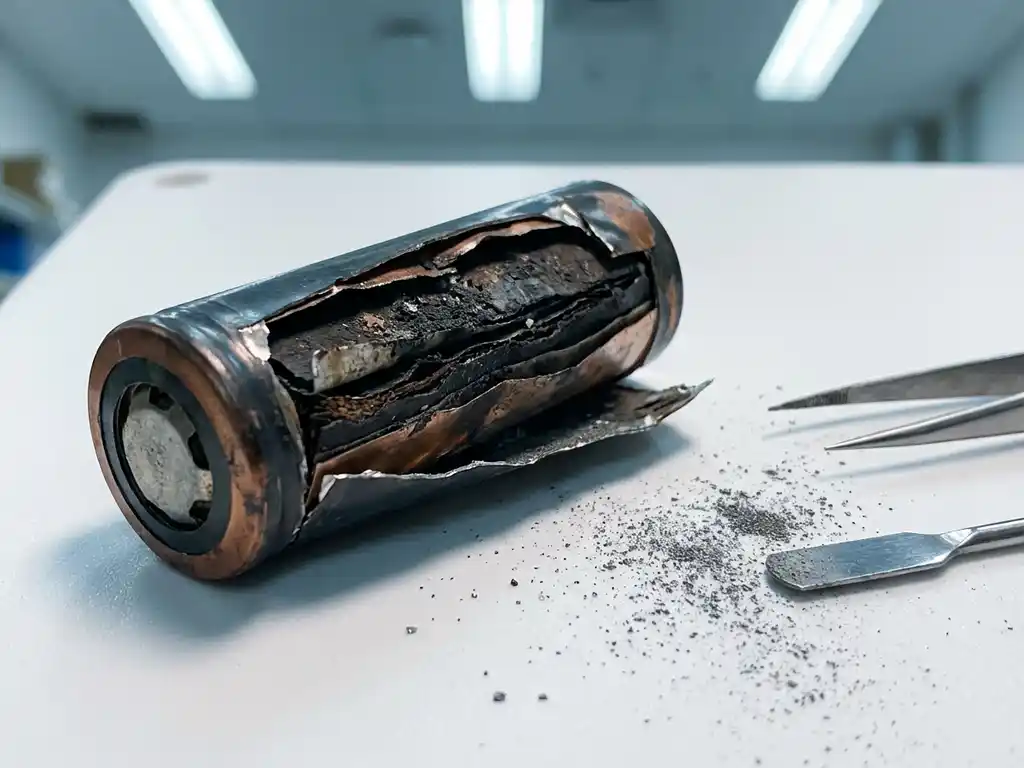
Lithium-ion batteries lose capacity permanently because of irreversible chemical and structural changes that occur within the cell during cycling, storage, and operation under stress. Unlike temporary capacity losses caused by temperature or state of charge, these mechanisms alter the electrode materials and electrolyte in ways that cannot be reversed by conditioning or rest. Understanding the root causes of lithium-ion battery capacity loss is essential for researchers working to improve cell longevity and develop next-generation energy storage materials.
The degradation mechanisms responsible for permanent capacity fade are numerous and often interdependent. Identifying and isolating each one requires controlled experimental conditions and precise measurement tools. This article outlines the principal mechanisms, their origins, and how researchers approach their quantification in the laboratory.
What does permanent capacity loss in lithium-ion batteries actually mean?
Permanent capacity loss in lithium-ion batteries refers to an irreversible reduction in the amount of charge a cell can store and deliver, expressed as a decline in specific capacity (mAh/g or mAh/cm²). Unlike reversible capacity fade, which can recover under different conditions, permanent capacity fade results from structural, chemical, or electrochemical changes that cannot be undone during normal operation.
Capacity is fundamentally limited by the number of lithium ions that can be reversibly inserted into and extracted from the electrode materials. When either the active material or the available lithium inventory is permanently consumed or structurally compromised, the cell’s maximum deliverable capacity decreases. Researchers typically track this as a percentage of the initial capacity over a defined number of cycles or a defined period of calendar time, providing a quantitative measure of battery aging mechanisms at work.
It is important to distinguish between two primary sources of permanent loss: loss of lithium inventory (LLI) and loss of active material (LAM). LLI occurs when lithium ions are consumed in parasitic side reactions and are no longer available for cycling. LAM occurs when electrode particles crack, dissolve, or become electronically isolated. Both contribute to the overall decline in lithium-ion battery lifespan, and both can occur simultaneously within the same cell.
What are the main mechanisms that cause irreversible capacity fade?
The main mechanisms causing irreversible capacity fade in lithium-ion batteries are solid electrolyte interphase (SEI) growth, lithium plating and dead-lithium formation, active material dissolution, particle cracking and mechanical degradation, and electrolyte decomposition. Each mechanism consumes either lithium inventory or active material, and most are accelerated by elevated temperature, high C-rates, or operation at extreme states of charge.
These mechanisms rarely act in isolation. SEI growth, for example, consumes lithium ions and increases cell impedance, which in turn raises overpotential during cycling. Higher overpotential can then trigger lithium plating at the anode, introducing a second and more severe degradation pathway. This coupling between mechanisms is one reason that battery capacity degradation tends to accelerate nonlinearly as a cell ages.
- Loss of lithium inventory (LLI): Lithium consumed in SEI formation, lithium plating, or reactions with contaminants is no longer available for reversible cycling.
- Loss of active material (LAM): Particle cracking, transition-metal dissolution, and electronic isolation of particles reduce the quantity of material that can participate in intercalation.
- Electrolyte decomposition: Solvent and salt breakdown products deposit on electrode surfaces, increasing resistance and contributing to SEI thickening.
- Structural disordering: Phase transformations and lattice distortions in cathode materials reduce the sites available for lithium insertion.
How does the solid electrolyte interphase cause capacity loss?
The solid electrolyte interphase (SEI) causes capacity loss by irreversibly consuming lithium ions during its formation and continued growth. The SEI forms on the anode surface during the first charge cycle, when the electrolyte reacts with the electrode at potentials below the electrolyte’s stability window. The lithium consumed in this process is permanently removed from the cell’s active inventory.
A thin, stable SEI is essential for cell operation—it passivates the anode surface and prevents continuous electrolyte reduction. However, the SEI is never fully static. Mechanical stresses from volume changes during cycling cause the SEI to crack and reform repeatedly, with each re-formation consuming additional lithium. Over hundreds of cycles, this ongoing growth contributes meaningfully to the overall permanent capacity fade observed in aged cells.
The composition and morphology of the SEI depend heavily on electrolyte formulation, electrode surface chemistry, temperature, and cycling protocol. Researchers studying SEI behavior often use electrochemical impedance spectroscopy (EIS) to track the evolution of SEI resistance over time, alongside post-mortem analysis techniques to characterize the layer’s chemical composition. The quality of the test-cell hardware matters considerably here: any electrolyte leakage, moisture ingress, or parasitic current from poorly sealed cells will introduce artifacts that confound SEI analysis.
Why does lithium plating lead to permanent battery degradation?
Lithium plating leads to permanent battery degradation because metallic lithium deposited on the anode surface can become electrically isolated from the electrode, forming so-called dead lithium that is permanently lost from the active inventory. Additionally, lithium dendrites formed during plating can penetrate the separator, creating internal short circuits that accelerate capacity fade and pose safety risks.
Plating occurs when the local overpotential at the anode is sufficient to drive lithium deposition rather than intercalation. This is most likely to happen at high C-rates, low temperatures, or when the anode is operating near full lithiation. In full cells, an imbalance between anode and cathode capacity can also make the anode susceptible to plating, even under moderate cycling conditions.
The capacity loss from lithium plating is compounded by the fact that each plating event also consumes electrolyte to form a new SEI layer around the deposited lithium. This dual consumption of both lithium inventory and electrolyte makes plating one of the most damaging mechanisms affecting lithium-ion battery lifespan. Detecting plating early, before it becomes severe, is an active area of research involving techniques such as EIS, differential voltage analysis, and in situ optical or strain monitoring.
How do researchers measure and quantify capacity loss in the lab?
Researchers measure and quantify capacity loss by tracking the discharge capacity delivered by a cell over successive cycles under controlled conditions, typically expressed as a percentage of the initial capacity. Complementary techniques, including electrochemical impedance spectroscopy (EIS), incremental capacity analysis (ICA), and differential voltage analysis (DVA), are used to attribute the observed fade to specific degradation mechanisms such as loss of lithium inventory or loss of active material.
Reliable quantification requires highly reproducible test cells. Variability in electrode preparation, electrolyte volume, stack pressure, or sealing quality introduces scatter in the data that can obscure the signal from the degradation mechanism under investigation. This is why standardized test cells with well-defined geometry and controlled assembly conditions are a prerequisite for publishable, peer-reviewed degradation studies.
Key measurement approaches used in degradation studies
- Galvanostatic cycling: Repeated charge and discharge at defined C-rates to track capacity retention over time.
- Electrochemical impedance spectroscopy (EIS): Frequency-resolved impedance measurements to separate contributions from SEI resistance, charge-transfer resistance, and diffusion.
- Incremental capacity analysis (ICA): Differentiation of the capacity-voltage curve to identify phase transitions and track their evolution with aging.
- Differential voltage analysis (DVA): Analysis of voltage-capacity derivatives to quantify LLI and LAM independently.
- Post-mortem analysis: Physical and chemical characterization of electrodes after cycling to correlate electrochemical signatures with structural changes.
In situ measurements add a further dimension by allowing researchers to monitor changes in real time without disassembling the cell. Strain measurements using an electrochemical dilatometer, for example, can reveal volume changes associated with SEI growth or lithium plating that are not visible in the voltage-capacity response alone.
What factors accelerate capacity fade the most?
The factors that most strongly accelerate capacity fade are elevated temperature, high C-rates, operation at extreme states of charge (very high or very low), and mechanical stress on electrode particles. Each of these conditions intensifies one or more of the underlying degradation mechanisms, significantly shortening the effective lithium-ion battery lifespan.
Temperature has a particularly strong influence because most degradation reactions—including SEI growth and electrolyte decomposition—follow Arrhenius kinetics, meaning their rates increase exponentially with temperature. Storage at high states of charge at elevated temperature is among the most damaging conditions for cathode materials, accelerating transition-metal dissolution and structural disordering.
- High C-rates: Increase overpotential at both electrodes, raising the risk of lithium plating at the anode and promoting electrolyte oxidation at the cathode.
- Elevated temperature: Accelerates all thermally activated degradation reactions, particularly SEI growth and cathode structural changes.
- Low temperature: Reduces lithium-ion mobility, increasing the risk of plating even at moderate C-rates.
- High upper cut-off voltage: Pushes cathode materials into structurally unstable states and increases electrolyte oxidation.
- Low lower cut-off voltage: Can cause copper current collector dissolution and accelerate anode degradation.
- Mechanical stress: Repeated volume changes during cycling cause particle cracking and loss of electronic contact, contributing to LAM.
Understanding how these factors interact is central to designing accelerated aging protocols that can predict long-term battery degradation from short-term laboratory tests. Precisely controlling these variables in experimental cells is therefore a fundamental requirement for any aging study.
How EL-Cell GmbH supports lithium-ion battery degradation research
Studying the mechanisms behind permanent capacity loss demands test cells that introduce no artifacts of their own. Variability in electrode compression, electrolyte distribution, or sealing integrity will obscure the degradation signal and compromise the reproducibility that peer-reviewed research requires. EL-Cell GmbH designs its test cells and instruments specifically to eliminate these sources of experimental error.
Our product portfolio addresses the key requirements of battery aging and degradation studies directly:
- Standardized test cells: The PAT series battery test cells provide defined geometry, controlled stack pressure, and reliable sealing to ensure reproducible cycling data across experiments and between laboratories.
- In situ strain measurement: The ECD-4-nano electrochemical dilatometer measures electrode thickness changes with a resolution better than 5 nm, enabling real-time monitoring of volume changes associated with SEI growth, lithium plating, and active material degradation.
- Integrated EIS capability: The PAT-Tester-i-16 combines galvanostatic cycling with potentiostat/galvanostat (PStat/GStat) and electrochemical impedance spectroscopy (EIS) functionality across up to 16 channels, supporting the multi-technique measurement approaches central to degradation quantification.
- Controlled cell environment: The temperature-controlled cell chamber integrated into the PAT-Tester-i-16 allows researchers to isolate the effect of temperature on degradation rates under well-defined conditions.
- Special-purpose cells: For studies requiring optical access or gas analysis, the ECC-Opto-10 and PAT-Cell-Press extend the range of in situ observables available during aging experiments.
If you are designing a battery aging study and want to discuss which test-cell configuration best fits your experimental requirements, contact the EL-Cell GmbH team directly. We are happy to support you in selecting or customizing the right solution for your research.
Comments are closed.