


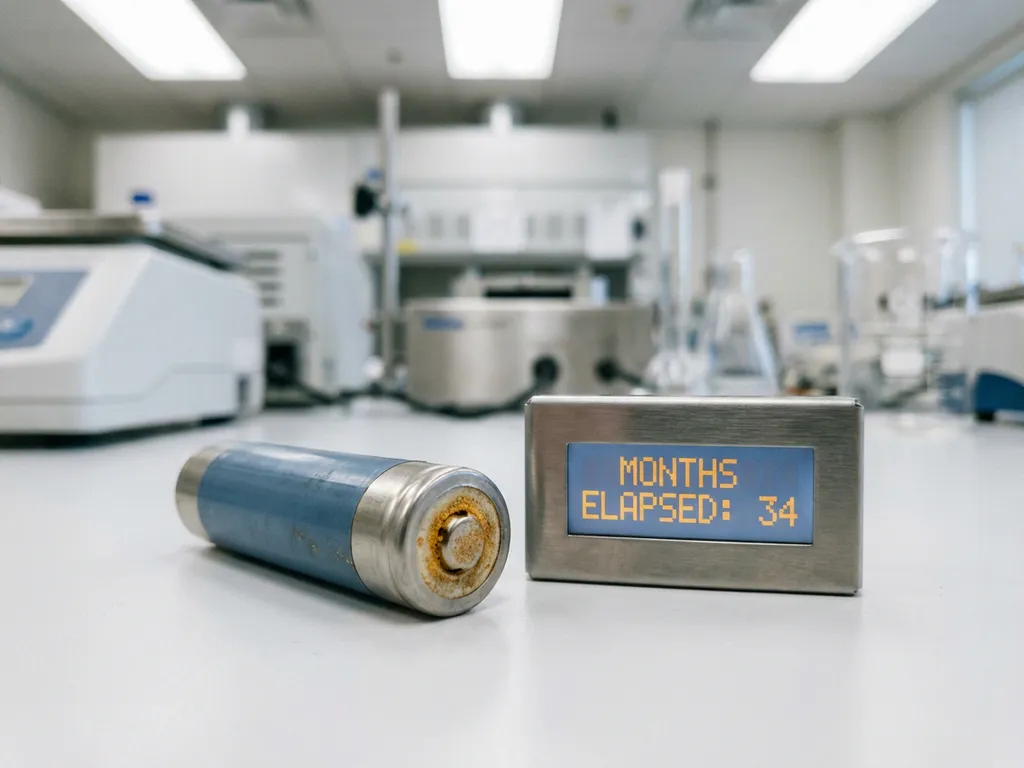
Calendar aging is one of the most practically significant degradation mechanisms in lithium-ion battery research, yet it is often studied separately from the cycling protocols that dominate laboratory testing. Understanding how a battery degrades simply through storage—without any charge or discharge activity—is essential for researchers developing materials, electrolytes, and cell formats intended for long-service applications. This article addresses the core questions around calendar aging in lithium-ion batteries, from its underlying electrochemical mechanisms to how it is characterised in a research setting.
What causes calendar aging in lithium-ion batteries?
Calendar aging in a lithium-ion battery refers to the capacity loss and impedance rise that occur during storage or rest, independent of cycling. It is driven primarily by parasitic reactions at the electrode–electrolyte interfaces, most notably the continued growth of the solid electrolyte interphase (SEI) on the graphite anode, which consumes cyclable lithium and increases cell resistance over time.
Even when a cell is not being cycled, thermodynamic instability between the electrolyte and the lithiated anode drives ongoing chemical reactions. The SEI layer, which first forms during initial charge cycles, is never fully stable. It continues to grow slowly as the electrolyte is reduced at the anode surface, consuming lithium ions that are permanently removed from the cell’s active inventory. This is the primary source of capacity loss during storage.
Additional mechanisms contribute to battery degradation during storage, depending on the chemistry and conditions:
- Electrolyte decomposition at the cathode surface, forming a cathode electrolyte interphase (CEI)
- Transition-metal dissolution from cathode active materials, particularly in layered-oxide chemistries
- Lithium plating on the anode at high states of charge, which can accelerate SEI growth
- Binder degradation and loss of electrical contact within the electrode microstructure
The relative contribution of each mechanism depends on the specific electrode materials, electrolyte formulation, and storage conditions. For researchers, isolating which mechanism dominates under a given set of conditions is one of the central challenges in calendar aging studies.
How does temperature affect battery calendar aging?
Temperature is the single most influential external variable in battery calendar aging. Higher storage temperatures accelerate all thermally activated parasitic reactions, particularly SEI growth, following Arrhenius kinetics. Even moderate increases in storage temperature—moving from room temperature to 40 or 60 degrees Celsius—can dramatically shorten the effective shelf life of a lithium-ion cell.
At elevated temperatures, the rate of electrolyte reduction at the anode surface increases significantly, thickening the SEI layer more rapidly and consuming available lithium. Cathode-side degradation also accelerates, with faster transition-metal dissolution and more extensive CEI formation observed at higher temperatures.
Conversely, low-temperature storage substantially slows calendar aging, which is why cold storage is used in some research protocols to preserve cells between test campaigns. However, very low temperatures introduce other concerns, such as changes in electrolyte viscosity and potential mechanical stress on electrode coatings during thermal cycling.
For researchers designing calendar aging experiments, controlling and logging storage temperature with precision is not optional. Small variations in ambient temperature over a storage period can introduce systematic error into capacity-fade measurements, making temperature-controlled environments a fundamental requirement for reproducible results.
How does state of charge affect calendar aging?
State of charge (SoC) during storage has a strong influence on the rate of calendar aging. Lithium-ion batteries stored at high SoC degrade faster than those stored at lower SoC because a more highly lithiated anode has a lower electrochemical potential, increasing the thermodynamic driving force for electrolyte reduction and SEI growth.
At high SoC, the anode is more fully lithiated and therefore more reactive toward the electrolyte. This accelerates parasitic reduction reactions and promotes faster lithium-inventory loss. Cathode instability is also more pronounced at high SoC, as delithiated cathode materials are generally more oxidising and more prone to structural changes and surface reactivity.
Storage at an intermediate SoC—commonly around 50%—is frequently used in research protocols to slow calendar aging when cells need to be preserved between test intervals. This is not simply a practical recommendation; the SoC dependence of the aging rate is itself a subject of active research, as understanding the precise relationship between SoC and degradation kinetics informs both material design and battery-management strategies.
What’s the difference between calendar aging and cycle aging?
Calendar aging and cycle aging are two distinct but overlapping modes of lithium-ion battery degradation. Calendar aging occurs during storage or rest and is driven by time, temperature, and SoC. Cycle aging occurs during charge and discharge and is driven by the mechanical and electrochemical stresses imposed by repeated lithium intercalation and deintercalation.
The mechanisms involved differ in important ways:
- Calendar aging is dominated by SEI growth, electrolyte decomposition, and interface reactions that proceed continuously over time at rest
- Cycle aging involves additional mechanisms, including electrode-particle cracking, active-material delamination, lithium plating during fast charging, and accelerated SEI re-formation following mechanical disruption
In practice, the two modes interact. A cell that has experienced significant calendar aging will often show altered cycling behaviour because a thicker SEI layer increases internal resistance and changes the kinetics of lithium insertion. Separating the contributions of calendar and cycle aging to total capacity loss is a significant experimental challenge, requiring carefully designed protocols that isolate rest periods from cycling intervals.
For researchers, distinguishing between these two degradation pathways matters because the remediation strategies differ. Electrode materials or electrolyte additives that suppress SEI growth are most relevant to calendar aging, while structural reinforcement of active-material particles addresses cycle-induced mechanical degradation.
How is calendar aging measured in battery research?
Calendar aging is measured by storing cells under controlled conditions of temperature and SoC, then periodically characterising their electrochemical state through standardised check-up protocols. The core metrics tracked are capacity fade, impedance rise, and changes in open-circuit voltage, measured at defined intervals over the storage period.
Standard check-up protocols
A typical calendar aging study involves storing cells at a fixed temperature and SoC, then removing them at regular intervals for electrochemical characterisation. A check-up protocol commonly includes:
- A capacity measurement using a low C-rate discharge to determine remaining capacity relative to the initial value
- Electrochemical impedance spectroscopy (EIS) to track changes in interfacial resistance and diffusion characteristics
- Open-circuit voltage (OCV) measurements to detect changes in thermodynamic state
- Coulombic-efficiency measurements to quantify irreversible lithium consumption per cycle
Dilatometry as a complementary technique
Electrode thickness changes during storage can also provide mechanistic insight. Electrochemical dilatometry tracks dimensional changes in the electrode stack with high resolution, allowing researchers to correlate SEI growth with measurable swelling at the anode. This is particularly useful when investigating how different electrolyte formulations influence the mechanical properties and thickness of the SEI layer during calendar aging.
Reproducibility is paramount in calendar aging studies. Because the degradation rates involved are slow and the differences between test conditions can be subtle, any variability introduced by the test-cell hardware itself—inconsistent contact pressure, electrolyte leakage, or temperature gradients within the cell—will obscure the signal of interest. Standardised test cells with well-defined geometry and controlled assembly conditions are therefore essential for generating data that can be compared across studies or between laboratories.
How EL-Cell GmbH supports calendar aging research
Studying calendar aging demands precise control over storage conditions and highly reproducible electrochemical characterisation at each check-up interval. EL-Cell GmbH designs and manufactures test cells and instruments specifically suited to this type of long-duration, precision battery research. Our products address the core requirements of a calendar aging study:
- The PAT series test cells provide standardised, reproducible cell geometry with consistent contact pressure, minimising hardware-introduced variability across stored samples
- The PAT-Tester-i-16 integrates a battery tester, a temperature-controlled cell chamber, and a docking station into one instrument, enabling controlled-temperature storage and automated check-up measurements across up to 16 channels simultaneously
- The ECD-4-nano electrochemical dilatometer, with a thickness resolution better than 5 nanometres, allows researchers to monitor electrode swelling during storage as a direct indicator of SEI growth
- EIS capability built into the PAT-Tester-i-16 supports impedance tracking as part of standardised check-up protocols without requiring a separate instrument
If you are designing a calendar aging study and need test cells or instrumentation that can support long-duration experiments with the reproducibility required for publishable results, contact EL-Cell GmbH to discuss your experimental requirements.
Comments are closed.