


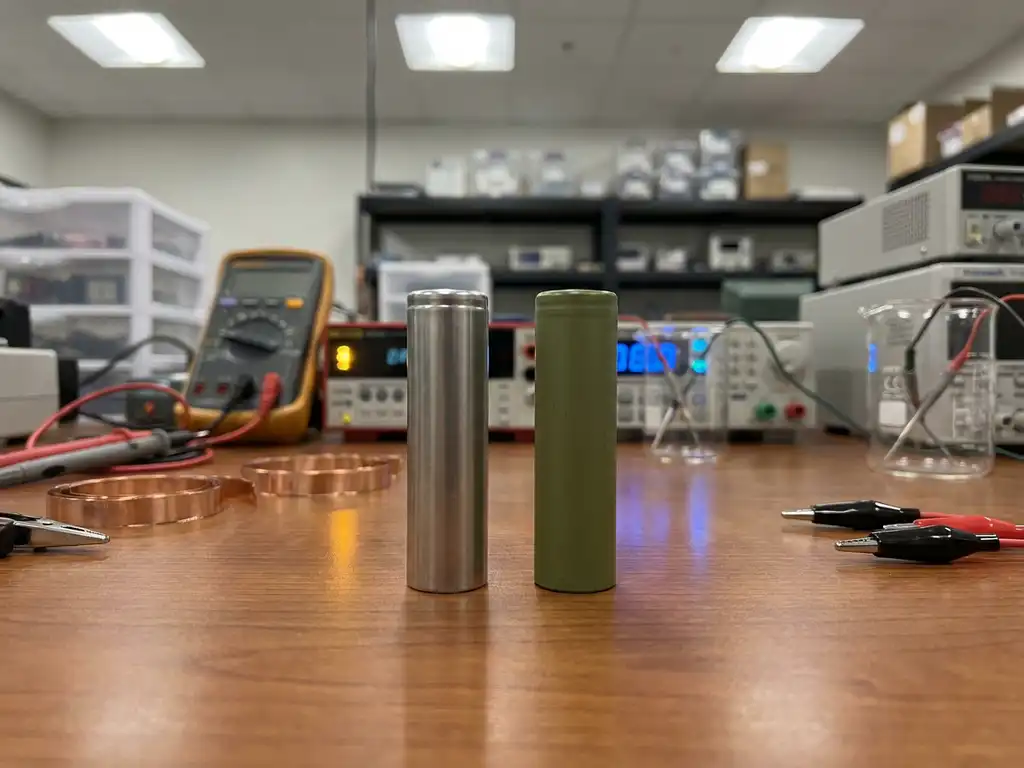
Lithium-ion and lithium iron phosphate batteries are both rechargeable electrochemical energy storage systems, but they differ significantly in cathode chemistry, electrochemical behaviour, and suitability for different research and application contexts. Understanding these differences is essential for battery materials researchers selecting chemistries to investigate or compare in the laboratory.
The term “lithium-ion battery” is broad and encompasses many cathode chemistries, of which lithium iron phosphate (LiFePO4, commonly abbreviated as LFP) is one specific example. This article clarifies the distinction, outlines the key electrochemical differences, and discusses how researchers approach testing these chemistries in a controlled laboratory environment.
What is a lithium-ion battery and how does it work?
A lithium-ion battery is an electrochemical cell that stores and releases energy through the reversible intercalation of lithium ions between a cathode and an anode. During charging, lithium ions deintercalate from the cathode and intercalate into the anode (typically graphite); during discharge, the process reverses. Electron flow through the external circuit performs electrical work.
The term “lithium-ion” refers to the charge-carrying mechanism rather than a single chemistry. Common cathode materials include lithium cobalt oxide (LCO), lithium nickel manganese cobalt oxide (NMC), lithium nickel cobalt aluminium oxide (NCA), and lithium iron phosphate (LFP). Each cathode material produces a distinct electrochemical profile in terms of specific capacity (mAh/g), operating voltage, thermal stability, and cycle life.
On the anode side, graphite remains the dominant material in commercial cells, though silicon-based anodes and lithium-metal anodes are active research targets. A solid electrolyte interphase (SEI) layer forms on the anode surface during the first charge cycles, consuming a portion of the lithium inventory and reducing initial coulombic efficiency. This SEI formation is a critical parameter researchers characterise when evaluating new anode materials.
What is a lithium iron phosphate battery?
A lithium iron phosphate battery is a lithium-ion cell that uses LiFePO4 as the cathode active material. LFP has an olivine crystal structure and operates at a nominal voltage of approximately 3.2 V versus Li/Li+. Its theoretical specific capacity is around 170 mAh/g, which is lower than that of NMC or NCA cathodes, but it offers notable advantages in thermal and chemical stability.
The olivine structure of LiFePO4 is particularly resistant to oxygen release during overcharge or thermal stress, which is a key factor in its safety profile. The iron–phosphate bond is stronger than the metal–oxygen bonds in layered oxide cathodes, making structural degradation under cycling less pronounced. This stability translates into longer cycle life under many practical cycling conditions.
LFP cathodes also exhibit a flat discharge voltage plateau, which is characteristic of a two-phase intercalation mechanism. This flat plateau simplifies state-of-charge estimation in some respects but can complicate voltage-based diagnostics. Researchers studying LFP often use techniques such as differential voltage analysis (dV/dQ) or electrochemical impedance spectroscopy (EIS) to extract degradation information that the flat voltage profile would otherwise obscure.
What are the main differences between lithium-ion and lithium iron phosphate batteries?
The main differences between lithium-ion batteries (as a general class) and LFP specifically relate to specific capacity, operating voltage, energy density, thermal stability, cycle life, and raw-material cost. LFP trades lower energy density for superior stability and longevity compared with high-nickel cathode chemistries such as NMC 811 or NCA.
The following comparison summarises the key electrochemical and material distinctions:
- Specific capacity: LFP delivers approximately 150 to 165 mAh/g in practical cells; NMC and NCA cathodes typically achieve 180 to 220 mAh/g, depending on nickel content and upper cut-off voltage.
- Operating voltage: LFP operates at approximately 3.2 to 3.4 V versus Li/Li+; NMC and NCA operate at approximately 3.6 to 3.8 V, contributing to higher energy density.
- Thermal stability: LFP is significantly more thermally stable; its decomposition temperature is higher, and it does not release oxygen under abuse conditions in the way layered oxides can.
- Cycle life: LFP cells routinely demonstrate superior cycle life under standard cycling conditions, retaining capacity over several thousand cycles in research settings.
- Raw-material cost: Iron and phosphate are abundant and less expensive than cobalt or high-purity nickel, making LFP cathode material more cost-effective at the materials level.
- Voltage profile: LFP has a flat, two-phase plateau; NMC has a sloping, solid-solution profile that provides richer electrochemical diagnostic information during cycling.
Which battery chemistry is safer — lithium-ion or LFP?
LFP is generally considered the safer cathode chemistry within the lithium-ion family. Its olivine crystal structure does not release oxygen during thermal runaway, which significantly reduces the risk of self-sustaining exothermic reactions. In contrast, layered oxide cathodes such as NMC and NCA can release oxygen at elevated temperatures, which can accelerate thermal runaway if electrolyte decomposition occurs simultaneously.
Safety in electrochemical cells is a multifactorial property that depends on cathode chemistry, electrolyte formulation, separator integrity, cell design, and operating conditions. LFP’s inherent cathode stability provides a wider thermal operating window, but this does not eliminate safety considerations related to electrolyte decomposition, lithium plating on the anode at high C-rates, or mechanical abuse.
For researchers conducting accelerated ageing studies or abuse testing, the difference in thermal behaviour between LFP and NMC cathodes is a meaningful experimental variable. Calorimetric and gas-evolution measurements, for example, will yield substantially different results between the two chemistries under equivalent conditions.
How do researchers test lithium-ion and LFP batteries in the lab?
Researchers test lithium-ion and LFP batteries in the lab using standardised electrochemical test cells that allow controlled cycling, impedance measurement, and physical characterisation of electrode materials. Half-cell configurations, in which the cathode or anode is tested against a lithium-metal counter electrode, are standard for characterising individual electrode materials before progressing to full-cell evaluation.
Half-cell versus full-cell testing
In a half-cell, the working electrode (a cathode material such as LFP or NMC, or an anode material) is cycled against a lithium-metal reference and counter electrode. This configuration isolates the electrochemical behaviour of a single electrode, making it suitable for measuring specific capacity (mAh/g), rate capability at different C-rates, and first-cycle coulombic efficiency. Full-cell testing, in which a matched cathode and anode are cycled together, is necessary to evaluate practical energy density, capacity balance, and long-term cycle life under realistic conditions.
Key electrochemical characterisation techniques
Standard characterisation methods applied to both lithium-ion and LFP electrodes include:
- Galvanostatic cycling: Charge and discharge at defined C-rates to measure specific capacity, coulombic efficiency, and capacity retention over cycles.
- Electrochemical impedance spectroscopy (EIS): Frequency-domain measurement of cell impedance to characterise SEI resistance, charge-transfer resistance, and diffusion behaviour. EIS is particularly informative for tracking degradation in LFP cells, where voltage-based diagnostics are limited by the flat plateau.
- Differential voltage analysis (dV/dQ) and incremental capacity analysis (dQ/dV): Numerical differentiation of the voltage–capacity curve to resolve phase transitions and detect degradation mechanisms.
- Electrochemical dilatometry: Measurement of electrode thickness change during cycling to quantify volume expansion and contraction, relevant for both graphite anodes and cathode materials, including LFP.
When should researchers choose LFP over other lithium-ion chemistries?
Researchers should choose LFP when the study requires a chemically stable, well-characterised cathode with long cycle life, low toxicity, and minimal sensitivity to overcharge. LFP is a preferred model system for studies focused on electrode kinetics, electrolyte interactions, or ageing mechanisms in which cathode instability would introduce confounding variables.
Specific research scenarios in which LFP is the appropriate chemistry include:
- Studies of anode materials in which a stable, well-understood cathode is needed to isolate anode behaviour in full-cell configurations.
- Long-duration cycling experiments requiring high cycle counts without significant cathode degradation.
- Electrolyte development research in which cathode reactivity with novel electrolyte formulations must be minimised.
- Solid-state battery research in which cathode–electrolyte interfacial stability is a primary variable and a reactive cathode would complicate interpretation.
- Research targeting stationary energy storage applications, in which the gravimetric energy-density penalty of LFP relative to NMC is acceptable.
Conversely, researchers investigating high-energy-density cathode materials, nickel-rich layered oxides, or capacity-fade mechanisms driven by structural disorder will find NMC or NCA chemistries more relevant to their research questions.
How EL-Cell GmbH supports lithium-ion and LFP battery research
EL-Cell GmbH designs and manufactures electrochemical test cells and instruments specifically for battery materials research, providing the hardware infrastructure needed to characterise both LFP and broader lithium-ion chemistries with precision and reproducibility.
Our product range addresses the key experimental requirements discussed in this article:
- Standardised test cells: The PAT-Cell provides reproducible half-cell and full-cell configurations for cycling LFP, NMC, NCA, and other cathode materials under controlled conditions, minimising experimental artefacts that can compromise publishable results.
- Electrochemical impedance spectroscopy: The PAT-Tester-i-16 integrates potentiostat/galvanostat (PStat/GStat) and EIS capabilities across up to 16 channels, enabling parallel impedance characterisation of multiple cells—essential for statistically robust ageing studies.
- Electrochemical dilatometry: The ECD-4-nano measures electrode thickness changes with a resolution better than 5 nm, allowing quantification of volume changes in LFP and other cathode materials during cycling.
- Solid-state and specialised configurations: The PAT-Cell-Solid supports testing of solid-state electrolyte systems, relevant for researchers comparing LFP behaviour in liquid versus solid electrolyte environments.
- Gas analysis: The PAT-Cell-Press and PAT-Cell-Gas enable in situ gas-evolution measurements, applicable to electrolyte decomposition studies across different cathode chemistries.
If you are designing experiments to compare LFP with other lithium-ion cathode chemistries, or need a reproducible platform for long-duration cycling studies, contact EL-Cell GmbH to discuss which test cell configuration best suits your research requirements.
Comments are closed.