


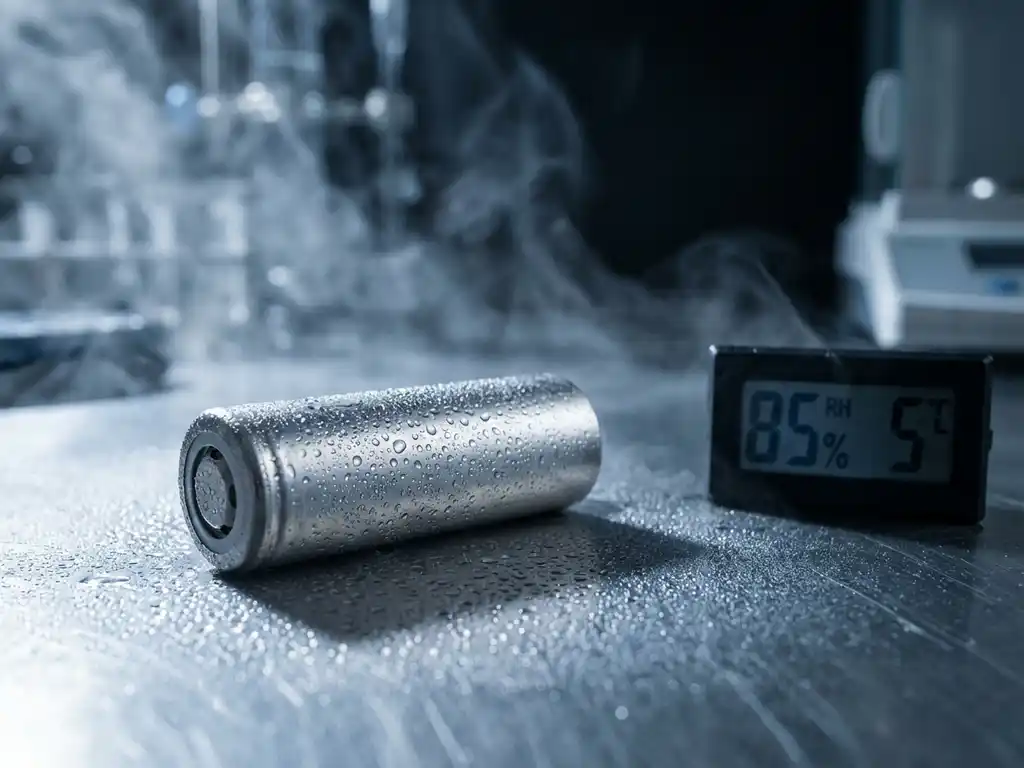
Humidity is one of the most consequential environmental variables in lithium-ion battery research. Moisture exposure during cell assembly, storage, or testing can introduce electrochemical artefacts that compromise experimental data and, in severe cases, render results unpublishable. Understanding how humidity affects lithium-ion battery materials and test cells is therefore a practical necessity for any battery materials researcher working under rigorous conditions.
This article addresses key questions surrounding battery storage humidity, moisture-induced degradation, and the environmental controls researchers rely on to maintain experimental integrity.
What happens to battery electrolyte when exposed to moisture?
When lithium-ion battery electrolyte is exposed to moisture, water reacts with the lithium hexafluorophosphate (LiPF₆) salt commonly used in liquid electrolytes to produce hydrofluoric acid (HF). This reaction is rapid even at low water concentrations and generates highly corrosive byproducts that attack electrode surfaces, current collectors, and separator materials, leading to irreversible capacity loss and elevated cell impedance.
The reaction pathway begins with LiPF₆ hydrolysing to form POF₃ and LiF, followed by further hydrolysis that produces HF. Even trace quantities of HF are sufficient to dissolve transition-metal oxides from cathode active materials such as LiCoO₂ or NMC, releasing metal ions that can migrate to the anode and disrupt the solid electrolyte interphase (SEI) layer. The SEI layer, which forms on the anode during the first charge cycles, is critical for long-term cycling stability. Once compromised by HF-mediated dissolution products, the SEI becomes thicker and less uniform, increasing overpotential and reducing coulombic efficiency.
Beyond LiPF₆-based systems, moisture also reacts destructively with lithium-metal anodes used in half-cell configurations. Lithium reacts with water to form lithium hydroxide and hydrogen gas, which is both a safety concern and a source of internal pressure that distorts cell geometry and test data.
What humidity levels are safe for lithium-ion battery storage?
For lithium-ion battery materials and assembled test cells, a relative humidity below 1% is generally considered necessary for safe storage and handling. Most research-grade operations use a dry-room environment maintained at a dew point of approximately -40°C or lower, or an inert-atmosphere glovebox purged with argon or nitrogen to achieve moisture levels below 1 ppm.
The precise tolerance depends on the materials involved:
- Lithium-metal anodes: Require sub-ppm moisture levels; even brief exposure to ambient humidity causes surface oxidation and dendrite-promoting contamination.
- Sulfide-based solid electrolytes: React with atmospheric moisture to release hydrogen sulfide (H₂S), making strict inert-atmosphere control essential.
- Oxide-based solid electrolytes: More tolerant of humidity, though prolonged exposure still degrades ionic conductivity at grain boundaries.
- Conventional liquid electrolytes (LiPF₆ in carbonate solvents): Moisture content should remain below 20 ppm within the electrolyte itself; storage containers must be sealed and kept in dry conditions.
Standard laboratory ambient conditions of 40 to 60% relative humidity are entirely unsuitable for cell assembly or open electrolyte handling. Even short exposure at ambient humidity can introduce enough water to measurably alter electrochemical behaviour in sensitive half-cell experiments.
How does humidity-induced degradation affect battery research results?
Humidity-induced degradation introduces systematic experimental artefacts that distort electrochemical measurements, making it difficult to distinguish genuine material behaviour from moisture-related side reactions. The most direct effect is a reduction in measured specific capacity (mAh/g) and coulombic efficiency, which can be misattributed to intrinsic material limitations rather than contamination.
Researchers relying on electrochemical impedance spectroscopy (EIS) are particularly affected. Moisture contamination increases the resistance of the SEI layer and electrolyte, shifting impedance spectra in ways that can be incorrectly interpreted as changes in electrode kinetics or ionic transport properties. This undermines the validity of equivalent-circuit fitting and the conclusions drawn from it.
Additional consequences for research data integrity include:
- Elevated self-discharge rates, which alter open-circuit voltage measurements and rest-period protocols.
- Inconsistent first-cycle irreversible capacity loss, making it harder to compare results across cells assembled under different humidity conditions.
- Accelerated capacity fade during cycling, which obscures the true long-term performance of electrode materials under investigation.
- Gas evolution within sealed test cells, which can increase internal pressure and affect measurements in cells equipped with pressure or strain sensors.
Reproducibility, which is the foundation of publishable battery research, depends directly on controlling these variables. A single poorly assembled cell exposed to elevated humidity can introduce outliers that invalidate an entire dataset.
How can researchers control humidity during battery cell assembly?
Researchers control humidity during battery cell assembly primarily by working inside an argon- or nitrogen-filled glovebox, which maintains moisture and oxygen levels below 1 ppm. For less moisture-sensitive materials, a dry room with a controlled dew point is an acceptable alternative, provided the dew point is consistently monitored and maintained below -40°C.
Glovebox protocols
Effective glovebox operation requires disciplined material-transfer procedures. All components, including electrodes, separators, electrolyte, and cell hardware, must be dried and degassed before introduction into the glovebox antechamber. Typical drying protocols involve vacuum ovens at temperatures appropriate to the material, followed by immediate transfer under an inert atmosphere. Regeneration cycles for glovebox purification systems must be performed regularly to maintain specification-level purity for moisture and oxygen.
Electrolyte handling and storage
Electrolyte solutions should be stored in sealed, moisture-proof containers within the glovebox or dry room at all times. Opened electrolyte bottles should not be returned to long-term storage without being resealed under inert gas. Water content in electrolytes can be verified using Karl Fischer titration, which provides a quantitative measure of moisture in ppm and allows researchers to confirm that electrolyte quality meets experimental requirements before use.
Cell hardware and assembly practices
Cell hardware should be cleaned, dried, and stored in a desiccated environment before assembly. Torque-controlled cell closure, as used in research-grade test cells such as the PAT-Cell, ensures consistent sealing that prevents post-assembly moisture ingress during storage and testing outside the glovebox.
What are the signs of humidity damage in a lithium-ion battery?
Signs of humidity damage in a lithium-ion battery test cell include abnormally low first-cycle coulombic efficiency, unexpectedly high impedance in EIS measurements, accelerated capacity fade during galvanostatic cycling, and visible corrosion or discolouration on electrode surfaces or current collectors when the cell is disassembled post-mortem.
In practice, the first indication is often a deviation from expected electrochemical behaviour during initial characterisation. A cell assembled from well-characterised electrode materials that shows significantly lower specific capacity than literature values, or an unusually large irreversible capacity loss in the first cycle, warrants investigation of the assembly environment and component moisture content.
Post-mortem inspection provides more direct evidence:
- White or grey deposits on the lithium-metal anode surface, indicating lithium hydroxide or lithium carbonate formation from moisture or CO₂ exposure.
- Corrosion pitting on aluminium current collectors, consistent with HF attack from LiPF₆ hydrolysis.
- Separator discolouration or degradation, which can indicate electrolyte decomposition driven by moisture-initiated side reactions.
- Swelling or deformation of the cell casing, which may indicate gas evolution from moisture-driven reactions within the cell.
When these signs are present, the affected cells should be excluded from the dataset, and the root cause should be addressed before further experiments are conducted. Correlating post-mortem observations with electrochemical data is a standard diagnostic approach in rigorous battery materials research.
How EL-Cell GmbH supports controlled battery testing environments
Maintaining strict humidity control throughout the battery research workflow is only effective when the test cells themselves are designed to preserve that controlled environment. EL-Cell GmbH produces research-grade electrochemical test cells and instruments that support the assembly and testing standards described in this article.
Specifically, our products address humidity-related research challenges in the following ways:
- The PAT-Cell and related test cells are designed for glovebox-compatible assembly, with torque-controlled closure that ensures consistent, reproducible sealing and minimises post-assembly moisture ingress.
- The ECD-4-nano electrochemical dilatometer measures electrode thickness changes with a resolution below 5 nm, enabling researchers to detect the subtle swelling caused by moisture-induced SEI growth or gas evolution that would otherwise remain undetected.
- The PAT-Tester-i-16 integrates a temperature-controlled cell chamber with up to 16 independent test channels and full EIS capability, allowing researchers to conduct controlled experiments in which environmental variables, including temperature and humidity exposure history, are precisely documented.
- The PAT-Cell-Gas supports in situ gas analysis, which is directly relevant to detecting hydrogen or other gases produced by moisture-driven reactions within the cell.
If you are designing or optimising a battery research workflow and need test cells or instrumentation that support controlled-atmosphere assembly and highly reproducible electrochemical measurements, contact EL-Cell GmbH to discuss your specific experimental requirements.
Comments are closed.